Customers today expect businesses to provide quick answers, instant support, and personalized experiences. A website is no longer just an online brochure—it has become an important channel for customer communication, sales, and lead generation.
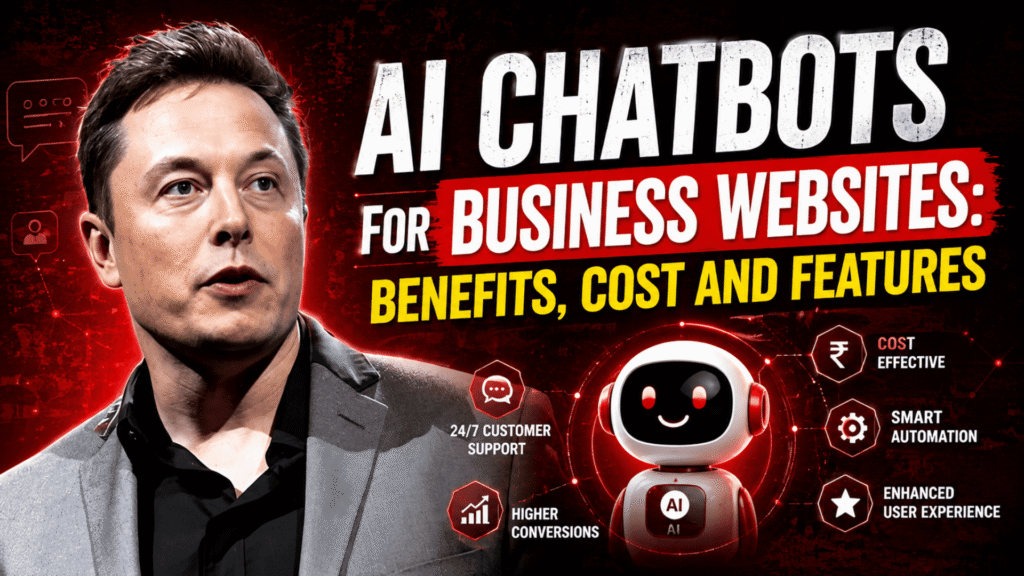
AI Chatbots for Business Websites are helping businesses automate conversations, answer customer questions, generate leads, and provide support around the clock. With artificial intelligence and natural language processing, modern chatbots can understand customer queries and provide relevant responses without requiring a support executive for every interaction.
In this guide, we will explore the benefits, features, cost, use cases, and important factors businesses should consider before implementing an AI chatbot.
Table of Contents
What Are AI Chatbots for Business Websites?
AI Chatbots for Business Websites are software applications that use artificial intelligence to communicate with website visitors through automated conversations.
Unlike traditional rule-based chatbots that can only respond to predefined commands, AI-powered chatbots can understand natural language and handle a wider range of customer questions.
For example, a visitor may ask:
- What services do you provide?
- How much does your service cost?
- Can I schedule a consultation?
- Where is your office located?
- How long does delivery take?
- Can I speak with a representative?
The chatbot can provide instant responses based on the information, knowledge base, and business data provided to it.
Why Businesses Need AI Chatbots
Website visitors often leave a website when they cannot find the information they need quickly. Long response times can result in lost leads and poor customer experiences.
AI Chatbots for Business Websites can solve this problem by providing immediate assistance while visitors are browsing a website.
Businesses can use chatbots to:
- Answer frequently asked questions
- Capture customer enquiries
- Generate and qualify leads
- Recommend products or services
- Schedule appointments
- Provide basic technical support
- Collect customer information
- Direct visitors to relevant website pages
- Transfer complex conversations to human agents
This makes the website more interactive while allowing employees to focus on more important tasks.
Benefits of AI Chatbots for Business Websites
1. 24/7 Customer Support
One of the biggest advantages of AI Chatbots for Business Websites is their ability to provide support 24 hours a day.
A chatbot does not need business hours, holidays, or breaks. Visitors can ask questions at any time and receive immediate assistance. This is particularly useful for businesses that serve customers across different cities, countries, or time zones.
2. Faster Response Times
Customers generally prefer businesses that respond quickly. Waiting several hours for an email response can cause potential customers to look elsewhere.
An AI chatbot can respond to common questions within seconds, helping businesses create a faster and smoother customer experience.
3. Lead Generation
A chatbot can act as an automated lead-generation assistant. It can ask visitors questions about their requirements and collect details such as their name, phone number, email address, and service requirements.
This information can then be sent to the sales team for follow-up.
4. Reduced Customer Support Workload
Many customer support teams spend significant time answering repetitive questions.
AI Chatbots for Business Websites can automate these repetitive conversations, allowing employees to concentrate on complex customer issues that require human attention.
5. Improved Customer Experience
Visitors can get information without searching through multiple pages or waiting for a representative.
A well-designed chatbot can guide users through the website and provide relevant information based on their questions.
6. Better Sales Opportunities
Chatbots can engage visitors who are interested in a product or service but are not ready to contact the business directly.
By answering questions, recommending services, and collecting contact details, a chatbot can help move potential customers further through the sales funnel.
Key Features to Look For
When selecting AI Chatbots for Business Websites, businesses should consider the following features.
Natural Language Understanding
The chatbot should understand normal customer questions instead of requiring users to type specific commands.
Automated FAQ Responses
Businesses should be able to create a knowledge base containing common questions and answers.
Lead Capture
The chatbot should be capable of collecting contact information and customer requirements.
Human Handover
Not every question can be handled by AI. A good chatbot should allow customers to connect with a human representative when necessary.
CRM Integration
Integration with CRM platforms can help businesses automatically send chatbot-generated leads to their sales teams.
Multilingual Support
Businesses serving customers from different regions can benefit from chatbots that support multiple languages.
Analytics and Reporting
Chatbot analytics can provide information about conversations, frequently asked questions, leads generated, and customer engagement.
Website Integration
The chatbot should work smoothly with the existing website without negatively affecting page speed or user experience.
How Much Do AI Chatbots Cost?
The cost of AI Chatbots for Business Websites can vary significantly depending on the business requirements and chatbot complexity.
A basic chatbot with predefined answers may cost less than an advanced AI chatbot that includes custom training, CRM integration, multilingual support, analytics, and advanced automation.
The main factors affecting chatbot development cost include:
- Chatbot complexity
- Number of website pages and services
- AI model and technology used
- Custom design and branding
- Third-party integrations
- CRM integration
- WhatsApp or social media integration
- Number of conversations
- Multilingual capabilities
- Maintenance and support
Businesses should therefore consider both the initial development cost and ongoing operating expenses before choosing a solution.
AI Chatbot vs Traditional Live Chat
Traditional live chat requires a human representative to respond to website visitors. While live chat can provide personalized support, it may not always be available.
An AI chatbot can handle basic conversations automatically and transfer more complicated queries to a human agent.
The best approach for many businesses is a hybrid model, where AI handles repetitive questions while human representatives manage complex or high-value conversations.
Industries That Can Benefit From AI Chatbots
AI Chatbots for Business Websites can be useful across many industries, including:
E-commerce
Chatbots can help customers find products, check order information, answer shipping questions, and provide product recommendations.
Real Estate
Real estate businesses can use chatbots to collect property requirements, share listings, qualify leads, and schedule property visits.
Healthcare
Websites can use chatbots for general information, appointment requests, clinic details, and frequently asked questions.
Education
Educational institutions can use chatbots to answer questions about courses, admissions, fees, application procedures, and schedules.
Travel and Hospitality
Hotels and travel businesses can automate questions about bookings, facilities, availability, check-in information, and services.
Professional Services
Law firms, digital marketing agencies, accounting firms, consultants, and other service providers can use chatbots to capture enquiries and schedule consultations.
How to Implement an AI Chatbot on Your Website
Implementing AI Chatbots for Business Websites should begin with clearly defining the business objective.
First, identify the questions customers ask most frequently. Next, determine which conversations should be automated and which should be transferred to a human representative.
The implementation process generally includes:
- Define chatbot objectives.
- Identify common customer questions.
- Prepare website and business information.
- Select an AI chatbot platform or development approach.
- Design the conversation flow.
- Integrate the chatbot with the website.
- Connect CRM or other business tools if required.
- Test responses and user experience.
- Launch the chatbot.
- Monitor conversations and improve responses regularly.
Continuous optimization is important because customer questions and business information can change over time.
How AI Chatbots Improve Website Conversion
A chatbot can engage visitors at important points during their website journey.
For example, when a visitor spends time on a service page, the chatbot can offer assistance. If the visitor is interested in purchasing a service, the chatbot can collect contact information and pass the lead to the sales team.
This can help businesses reduce missed opportunities and make their websites more effective sales channels.
Are AI Chatbots Worth the Investment?
For businesses that receive regular website traffic, customer enquiries, or sales leads, AI Chatbots for Business Websites can provide significant value.
The benefits go beyond customer support. Businesses can use chatbots for marketing, sales, lead qualification, appointment scheduling, customer engagement, and information delivery.
However, businesses should avoid implementing a chatbot simply because AI is popular. The chatbot should have a clear purpose and solve a genuine customer or business problem.
Best Practices for Using AI Chatbots
For better results, businesses should follow these practices:
- Keep chatbot conversations simple.
- Provide accurate and updated information.
- Make it easy to contact a human representative.
- Avoid unnecessary questions.
- Protect customer information.
- Test the chatbot regularly.
- Monitor conversation analytics.
- Improve answers based on customer feedback.
- Make the chatbot mobile-friendly.
- Clearly communicate when users are interacting with AI.
A chatbot should make the customer journey easier—not create another obstacle.
Frequently Asked Questions
Are AI chatbots suitable for small businesses?
Yes. Small businesses can use chatbots to automate FAQs, collect leads, schedule appointments, and provide basic customer support without hiring additional staff for every interaction.
How long does it take to develop an AI chatbot?
The development time depends on the chatbot’s complexity. A basic chatbot can be implemented relatively quickly, while a customized solution with integrations and advanced functionality may require more development and testing.
Can an AI chatbot generate leads?
Yes. Chatbots can ask qualifying questions and collect contact information such as names, email addresses, phone numbers, and customer requirements.
Can a chatbot connect customers with human agents?
Yes. Human handover is an important feature for businesses that need to handle complex, sensitive, or high-value customer conversations.
Can AI chatbots work with CRM systems?
Yes. Many chatbot solutions can integrate with CRM platforms, allowing businesses to automatically transfer customer information and leads to their sales teams.
Conclusion
AI Chatbots for Business Websites are becoming an important part of modern digital strategies. They can provide 24/7 customer support, improve response times, generate leads, automate repetitive tasks, and create more engaging website experiences.
The right chatbot depends on the business’s goals, target audience, budget, website traffic, and integration requirements. Instead of focusing only on chatbot development cost, businesses should consider the long-term value it can provide through improved customer service, increased productivity, and potential lead generation.
As AI technology continues to evolve, businesses that adopt useful and customer-focused chatbot solutions can create smarter websites and provide faster, more convenient digital experiences.