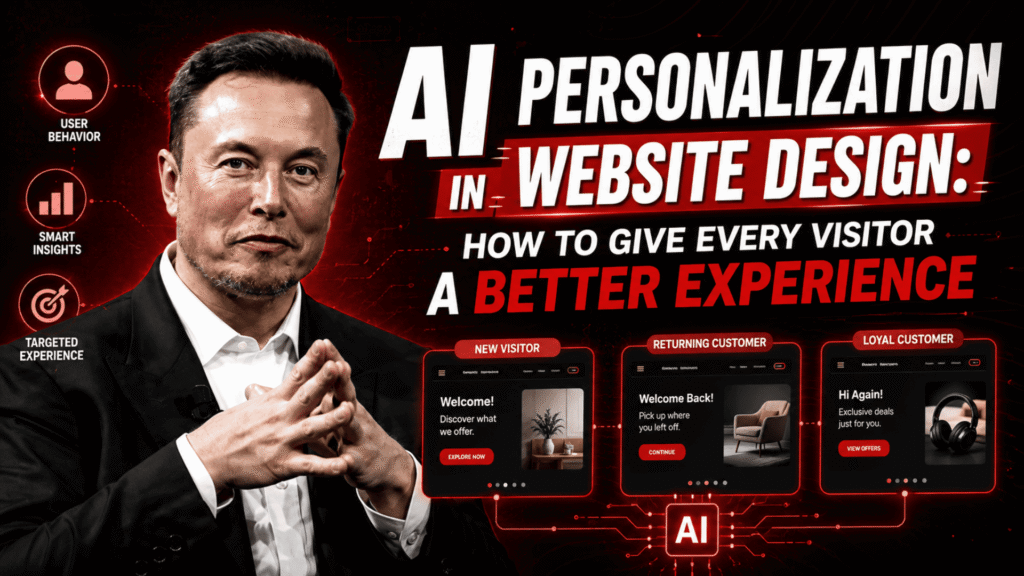
Today, visitors expect websites to provide more than attractive designs and basic information. They want fast loading pages, relevant content, easy navigation, personalized recommendations, and quick answers to their questions. This is where AI Personalization in Website Design is becoming an important strategy for modern businesses.
Artificial intelligence can analyze visitor behavior, preferences, interactions, and other website data to create more relevant digital experiences. Instead of showing exactly the same website experience to everyone, businesses can use AI to make websites more responsive to individual visitors.
For businesses looking to improve engagement, conversions, customer satisfaction, and online growth, understanding how AI personalization works can provide a significant advantage.
Table of Contents
What Is AI Personalization in Website Design?
AI Personalization in Website Design means using artificial intelligence to understand visitor behavior and deliver a more customized website experience.
Traditional websites generally show the same content, offers, navigation, and recommendations to every visitor. AI-powered websites can use available data to adjust certain elements based on user behavior.
For example, an e-commerce website may recommend products based on previous browsing activity. A service website may display content related to a visitor’s interests. An AI chatbot may provide answers based on the user’s questions.
The goal is simple: show visitors information that is more relevant to their needs.
Why Website Personalization Matters
Every website visitor has different needs. One person may be looking for pricing information, while another may want product details, reviews, or contact information.
Personalization helps businesses provide a more relevant experience instead of expecting every visitor to follow the same journey.
Effective personalization can help businesses:
- Improve user engagement
- Increase time spent on a website
- Improve conversion rates
- Provide better customer support
- Increase product discovery
- Improve customer satisfaction
- Create more relevant marketing experiences
When visitors quickly find what they need, they are more likely to take meaningful actions such as submitting a form, making a purchase, booking a service, or contacting a business.
How AI Personalization Works
AI personalization generally works by collecting and analyzing different types of website interaction data.
This may include:
- Pages visited
- Products viewed
- Search queries
- Previous interactions
- Referral sources
- Device type
- General browsing patterns
- Previous purchases
- Customer preferences
AI systems can analyze these signals and identify patterns. Based on those patterns, a website can provide recommendations or adjust specific elements of the visitor experience.
However, businesses should use customer data responsibly and follow applicable privacy and data protection requirements.
Personalized Content for Different Visitors
One of the most useful applications of AI Personalization in Website Design is personalized content.
Instead of showing identical content to every visitor, AI can help businesses identify which information may be most useful to a particular audience.
For example, a software company could show different content to a first-time visitor and a returning customer. A real estate website could recommend properties based on previous searches. An online retailer could highlight products related to previous browsing behavior.
Personalized content can make websites feel more relevant and useful.
AI-Powered Product Recommendations
Product recommendations are already an important part of many e-commerce websites.
AI can analyze browsing and purchasing patterns to recommend products that customers may be interested in. These recommendations can appear on product pages, category pages, shopping carts, or personalized dashboards.
For example, if a visitor frequently views running shoes, an AI-powered system may recommend running accessories, sportswear, or similar shoes.
This can help customers discover relevant products while also creating additional sales opportunities for businesses.
Personalized Website Navigation
Navigation is one of the most important elements of website usability. Visitors should be able to find important information without unnecessary effort.
AI can help businesses understand how different users interact with website navigation. Based on these insights, businesses can optimize menus, search functionality, calls-to-action, and content structures.
For websites with large amounts of information, intelligent search and personalized recommendations can make navigation even easier.
AI Chatbots for Personalized Customer Support
AI-powered chatbots are another major application of personalization.
A chatbot can answer frequently asked questions, provide product information, help visitors find services, collect leads, and guide customers through different website processes.
With appropriate data and configuration, AI chatbots can provide more relevant responses based on the questions visitors ask.
For example, a visitor asking about website development services may receive information about development packages, while someone asking about SEO may be guided toward relevant SEO services.
Personalized Calls-to-Action
Calls-to-action encourage visitors to take the next step. Common examples include:
- Get a Quote
- Book a Consultation
- Buy Now
- Contact Us
- Download a Guide
- Schedule a Demo
AI can help businesses determine which calls-to-action are more relevant to different visitor segments.
A first-time visitor may be encouraged to explore services, while a returning visitor may be shown a stronger conversion-focused CTA.
This type of personalization can make the customer journey more relevant and reduce unnecessary friction.
AI Personalization and User Experience
A good user experience is not only about colors, layouts, and animations. It is also about helping visitors accomplish their goals quickly.
AI Personalization in Website Design can support better user experiences by making websites more responsive to visitor needs.
For example, an AI-powered website can recommend relevant content, improve search results, provide instant assistance, and help users find suitable products or services.
When personalization is implemented correctly, visitors may feel that the website understands what they are looking for.
Improving Conversion Rates With Personalization
Conversions are one of the biggest reasons businesses invest in personalization.
A conversion can be any desired action, including:
- Completing a purchase
- Filling out a contact form
- Calling a business
- Booking an appointment
- Requesting a quotation
- Signing up for a newsletter
- Downloading a resource
Personalized experiences can help visitors reach these actions more easily by displaying relevant information at the right stage of their journey.
However, personalization should always be tested. Businesses should use analytics and conversion data to determine which strategies actually improve performance.
AI Personalization for Local Businesses
Local businesses can also benefit from AI Personalization in Website Design.
For example, a local service company can use personalized content to highlight relevant services, locations, offers, or customer questions.
A business website serving customers in a specific city can also create useful location-focused experiences while maintaining a natural and helpful user journey.
For businesses in competitive local markets, personalization can help create a website experience that feels more relevant than a generic website.
Personalization and SEO
SEO and personalization can work together, but businesses need to implement them carefully.
Search engines need to be able to access and understand important website content. Businesses should avoid creating completely different pages or content in ways that make important information inaccessible to search engines.
A strong SEO strategy should continue to focus on:
- Helpful content
- Search intent
- Relevant keywords
- Mobile usability
- Website speed
- Internal linking
- Technical SEO
- Structured content
- Good user experience
AI can support personalization while the website maintains a strong technical and content foundation.
Using AI Without Making the Website Complicated
Adding too many AI features can make a website confusing or difficult to manage. Businesses should focus on features that solve real customer problems.
Useful AI personalization features may include:
- Product recommendations
- Smart search
- AI chatbots
- Personalized content
- Dynamic offers
- Customer behavior analysis
- Personalized email experiences
The best approach is to start with one or two valuable features, measure the results, and expand personalization based on actual customer needs.
Privacy Should Be a Priority
Personalization depends on data, which means privacy should always be considered.
Businesses should be transparent about how customer information is collected and used. They should also implement appropriate security measures and comply with applicable privacy regulations.
Collecting more data does not automatically create a better experience. Businesses should focus on collecting and using information responsibly and only when it provides genuine value.
The Future of AI Personalization
The future of AI Personalization in Website Design is likely to become increasingly intelligent and interactive.
Websites may become better at understanding user intent, predicting customer needs, providing personalized recommendations, and adapting digital experiences in real time.
AI may also become more closely connected with customer relationship management systems, e-commerce platforms, analytics tools, and marketing automation.
This could allow businesses to create more connected customer journeys across websites and other digital channels.
Best Practices for AI Website Personalization
Businesses considering AI personalization should follow a strategic approach.
1. Understand Your Audience
Identify your target customers and understand their needs, problems, and online behavior.
2. Define Clear Goals
Decide whether personalization is intended to improve sales, leads, engagement, customer support, or another measurable goal.
3. Start Small
Begin with one useful personalization feature rather than trying to automate the entire website.
4. Test and Measure
Use analytics and conversion tracking to determine whether personalization is actually improving results.
5. Protect User Data
Use appropriate security and privacy practices when collecting and processing customer information.
6. Keep Human Oversight
AI should support business decisions rather than completely replace human expertise.
Why Businesses Should Invest in AI Personalization
AI Personalization in Website Design gives businesses an opportunity to move from generic websites toward more intelligent and customer-focused digital experiences.
Instead of treating every visitor the same, businesses can use AI to understand different customer needs and provide more relevant information.
For e-commerce companies, this can mean better product discovery. For service businesses, it can mean more relevant lead generation. For content websites, it can mean improved engagement.
The value of personalization ultimately comes from helping visitors find the right information at the right time.
Conclusion
AI is changing the way businesses think about website design and customer experience. Modern websites can use artificial intelligence to understand visitor behavior, recommend relevant content, improve navigation, provide personalized support, and create better conversion opportunities.
AI Personalization in Website Design can be especially valuable for businesses that want to create more relevant and user-focused online experiences.
However, successful personalization is not simply about adding AI tools to a website. Businesses need a clear strategy, useful data, strong website development, good UX design, SEO-friendly implementation, and responsible data practices.
As AI technology continues to develop, businesses that use personalization thoughtfully can create websites that are more helpful, engaging, and effective.
The future of website design is not just about creating one website for everyone. It is about creating better digital experiences that respond to what individual visitors actually need. That is why AI Personalization in Website Design will continue to play an important role in modern digital strategies.